Change career

Self-paced
Online courses at-your-own pace
Cybersecurity for BeginnersCohort-based
Learn with a group
AI Productivity BootcampYrkeshögskolan [SE]
Cybersecurity for Devs (YH)

As the final projects wrap up and LIA (internship) approaches, we checked in with Daniel Lauding from our JavaScript Development Programme.
With a background spanning 15+ years in design and product — including companies like Spotify and Swedbank — he returned to sharpen his skills in modern JavaScript and fullstack development. We spoke about his journey back to coding, and the idea behind Pejla — a project built to make sense of the explosion of ideas in an AI-driven world.
What made you get into coding and what did you do before?
It started with pure curiosity as a kid. I've always loved building things from scratch – it began with Lego, then I discovered Photoshop, Flash, computers and the early web. I got obsessed – building and redesigning my own sites over and over, making portfolio pages, adding hit counters and guestbooks, designing sites for Counter-Strike clans. Every time I saw something cool on someone else's site, I had to figure out how it was made and rebuild mine from scratch. That feeling of making something come to life never gets old.
That obsession turned into my first frontend role in 2008, right during the financial crisis, and then I went to Hyper Island to go deeper into digital media, UX, and product development.
Since then I've spent 15+ years as a product designer and design engineer, working with companies like Spotify, Swedbank, Länsförsäkringar, and KLM. I also co-founded a fintech company called Asteria that grew to serve users through Swedbank and PayEx.
Throughout my career I've worked in a hybrid space between design and code – UI, UX, web, apps, design systems — always close to the interface but not always deep in modern JavaScript. That's part of what brought me back to structured learning.
What drew you to Technigo?
I've always tried to keep evolving – Hyper Island was one chapter, and Technigo felt like the right next one. Over the years I've worked more on the design and product side, and while I've always been hands-on with code, I hadn't spent focused time on modern JavaScript, React, and fullstack development.
With AI-assisted development tools becoming so powerful – Cursor, Claude Code, Lovable — I saw an opportunity to work much more broadly as a design engineer. But to really pair with AI effectively, and to take a bigger role in teams or work independently as a freelancer, I needed to understand the full stack properly. Not just copy-paste from AI, but actually know what's happening under the hood. Technigo gave me that foundation – practical, project-driven, and focused on the JavaScript ecosystem I wanted to get sharper in.
What has been your favourite part of the programme so far?
Collaborating with classmates and pair programming. There's something about working through a problem together that makes things stick in a way that solo tutorials never do.
There's something about working through a problem together that makes things stick in a way that solo tutorials never do.
I also really enjoyed learning vanilla JavaScript first, then applying those fundamentals when moving into React — and then connecting everything to APIs and the backend stack. I've worked with React before, but mostly implementing CSS and presentational components. Getting the broader picture – state management, data fetching, API design, the full flow from database to UI — was eye-opening. It gave me a much clearer understanding of how everything fits together, and made me a lot more confident working across the whole stack.
What’s the idea behind your final project Pejla.io? Tell us about it!
With AI tools like Lovable, Replit, Claude Code, and all the new design and prototyping tools out there, it's become incredibly fast to generate alternatives – design variations, prototypes, code experiments, even music demos. That's amazing, but it also creates a jungle. You end up with ten versions of something and no structured way to decide which direction to go.
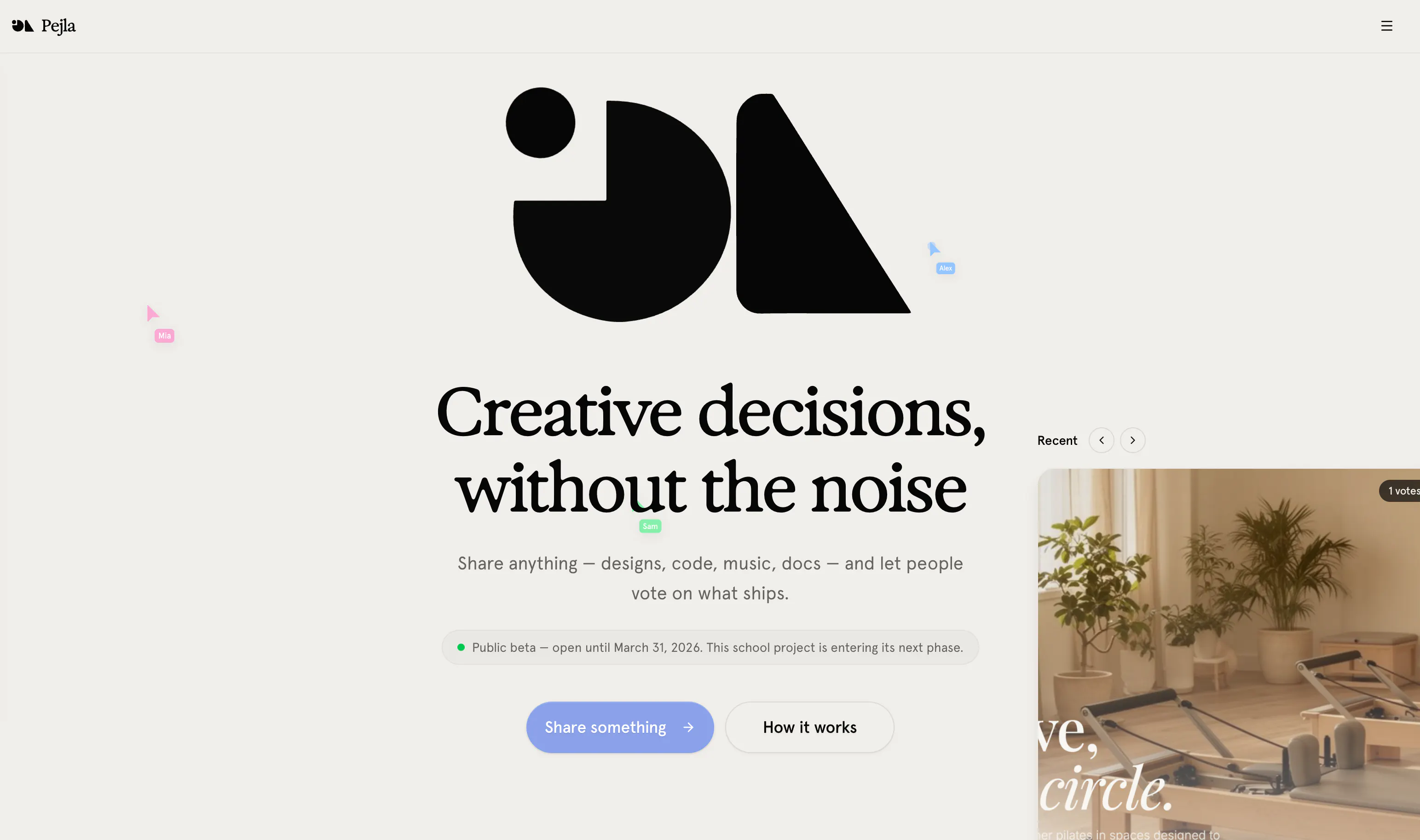
Pejla solves that. You upload your alternatives – designs, code snippets, sound clips, video, Figma embeds, whatever — share a link, and people vote on what works best. Think of it as a lightweight decision tool for creative work.
The name "Pejla" comes from Swedish – it means to gauge or test the waters, which is exactly what you do when you put work out for feedback. It works for design reviews, but also for a brief you're working on, a track you're producing, or a prototype you want your team to weigh in on. In a world where we can build and iterate so much faster, we need better ways to evaluate and find the right direction. That's what Pejla is for.
How did you approach building it, and what technologies did you use?
I started with the data model – how polls, options, votes, and remixes relate to each other – and built the backend with Node.js, Express, and MongoDB. Cloudinary handles media uploads since polls can contain images, video, and audio.
The frontend is React with TypeScript, Zustand for state management, Tailwind CSS with shadcn/ui components, and Framer Motion for animations. I also set up Storybook for component development.
My workflow is very design-in-code. I jump between Figma, AI tools, and the actual codebase constantly – tweaking CSS, adjusting layouts, updating the design and the code in parallel rather than doing a handoff between the two. That's how I naturally work, and it meant the design and the implementation evolved together rather than one leading the other. It's deployed at pejla.io with a custom domain.
What’s one thing you’re especially proud of?
The remix feature. In creative work, you rarely start from zero – you build on someone else's idea, or iterate on your own. Pejla captures that: when you remix a poll, it creates a linked variation that shows up as a branch in a remix tree on the original. The main feed stays clean, but the design evolution is preserved. It turned what could have been a simple voting app into something that reflects how creative iteration actually works.
I'm also proud that it's a real product, not just an assignment – it has a custom domain, real infrastructure, and a roadmap. I'm planning integrations for Figma and Slack to bring feedback directly into the tools teams already use.
Any tips for a future developer or anyone interested in starting to code?
Build something that solves a problem you actually have – that's what keeps you going when it gets tough. And honestly, the feeling when you crack something that's been driving you crazy for hours? There's nothing like it. That rush is what makes coding addictive.
Whatever your background, you're not starting from scratch. You already have skills that transfer – problem solving, understanding people, caring about the end result. Coding is just a new way to act on that.
And pair up with AI early – use it as a mentor and coding partner while you work. It'll speed you up massively, but make sure you understand what's happening underneath. That's what makes the difference.




We're a female-founded, remote-first community helping people get a career they love. 90% of those attending our boot camps are women.